Handrails and Railings
Steel handrail and guard rail, fabricated to the measured run, installed where it mounts, and repaired where the steel is still sound. On settled steps or a ramp with a turn in it, the rail is built to the actual geometry, not trimmed down from stock.
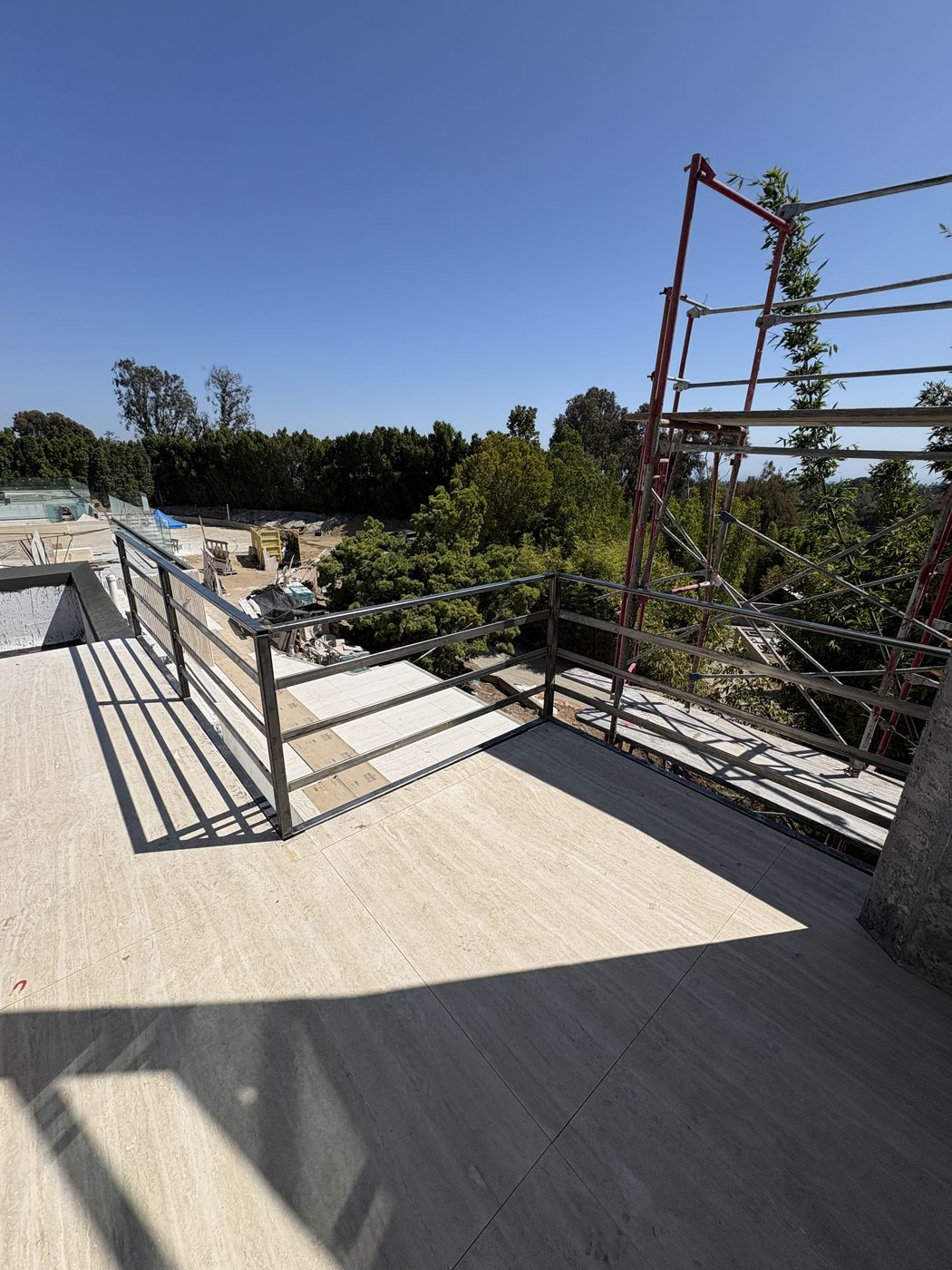
A handrail and a guard are two different items that usually get welded into one assembly. The handrail is what a hand closes around on a stair. The guard is the barrier along the open side of a raised walking surface, a landing or a mezzanine. Building departments check them separately, against the height and load numbers in the code the jurisdiction has adopted.
Steel tube rarely fails in the middle of a run; the connection at the bottom is what lets go. A post gets set one of three ways: a baseplate on top of the step, a side mount through the face of the concrete, or a core drilled hole with the post grouted in. A baseplate lands the anchors at the nosing, the weakest concrete on the step, where an expansion anchor can break a cone out the side even when the steel above it is sound.
Side mounting moves the fasteners back from that edge and keeps the tread clear, but the load arrives as pry instead of shear, so slab thickness matters more. On thick sound concrete we core drill and grout the post in, which holds well and is the least reversible of the three mounts. A wall mounted rail raises the same question, since a bracket lagged into stucco over lath has nothing structural behind it and has to reach a stud or the masonry behind the wall. We pick the mount on site, once the concrete is in front of us.
Rust starts at the bottom of a post and on the inside of the tube. Open tube collects water, so we cap the tops and put a drain at the low points. Anything closed heading out for hot dip galvanizing needs vent and drain holes anyway, because a galvanizer will not dip a sealed tube. At the base, water sits in the joint between the plate and the concrete, and that joint is the first place we cut into on a repair.
A primed and painted rail is easy to touch up and it takes a site weld without much fuss. Galvanizing under a powder topcoat lasts a great deal longer. The American Galvanizers Association reports that a duplex system, galvanizing plus an organic topcoat, lasts roughly 1.5 to 2.3 times the combined life of the two coatings on their own. Zinc thickness follows ASTM A123, keyed to how thick the steel is.
Powder over galvanizing carries one risk worth naming. Water and air can sit in the zinc coating and turn into pinholes in the powder if the part is not thermally treated first, which is the prep ASTM D7803 covers. For the topcoat we ask for an AAMA 2604 class powder rather than the basic 2603 class, a durability tier written for coatings on aluminum.
A guard along a pool deck can get counted toward the pool barrier, and plan check then holds it to the barrier rules. California Health and Safety Code 115923 sets a minimum height of 60 inches, no more than 2 inches of clearance underneath, and no gap that passes a 4 inch sphere, with an outside surface free of handholds and footholds. The statute does not name horizontal rails or cable, but a horizontal member at child height reads as a foothold, so that rail gets vertical pickets spaced to stop the sphere.
The same section puts the access gate on the barrier: it opens away from the pool, self closing, with a self latching device placed no lower than 60 inches above the ground. Section 115922 applies when a building permit is issued for a new pool or a remodel at a private single family home, and calls for at least two of seven drowning prevention features.
Before we quote a repair or a new run, send photos of the whole run and a close shot of each mount, and count the risers. We need to know what the rail dies into at each end, a wall or open air, whether the job is permitted, and whether a pool is nearby. Concrete work goes first, so the anchors land in sound material.
Work from our shops
Questions about handrails and railings
How tall does a handrail or guard have to be?
Can a rail be anchored to concrete steps that are already chipped?
Can I have horizontal rails or cable instead of pickets?
Painted, or galvanized and powder coated?
The bottom of my rail is rusted out. Does the whole thing get replaced?
Do you build guard rail for shops and loading docks?
Get handrails and railings in your city
Often paired with handrails and railings
Need handrails and railings?
Free estimates. Tell us the job and we will send back a spec and a price.