Gate Welding in Lancaster, CA
Gate welding is work on the steel of a gate you already have: hinges, latches, frame corners, braces and the bottom rail. A mobile welder handles it at the gate when the leaf can stay put, and our Division Street shop in Lancaster takes it when the frame has to be pulled square on a table.

How gate welding is done, step by step
-
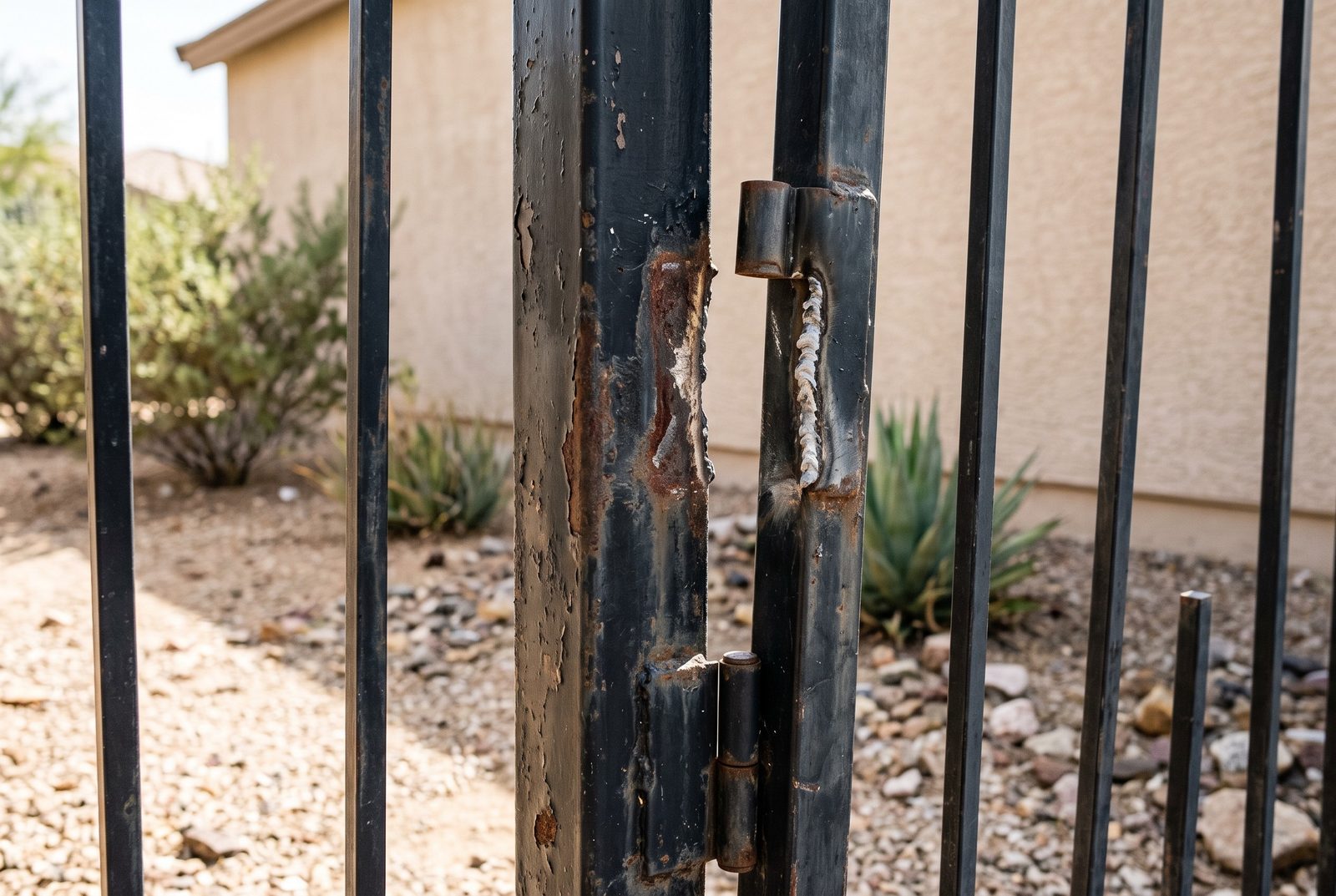
Look at the post
When a hinge tab tears loose, look at the post first. A post too light for its leaf flexes on every swing and pulls a new hinge off the same way.
-
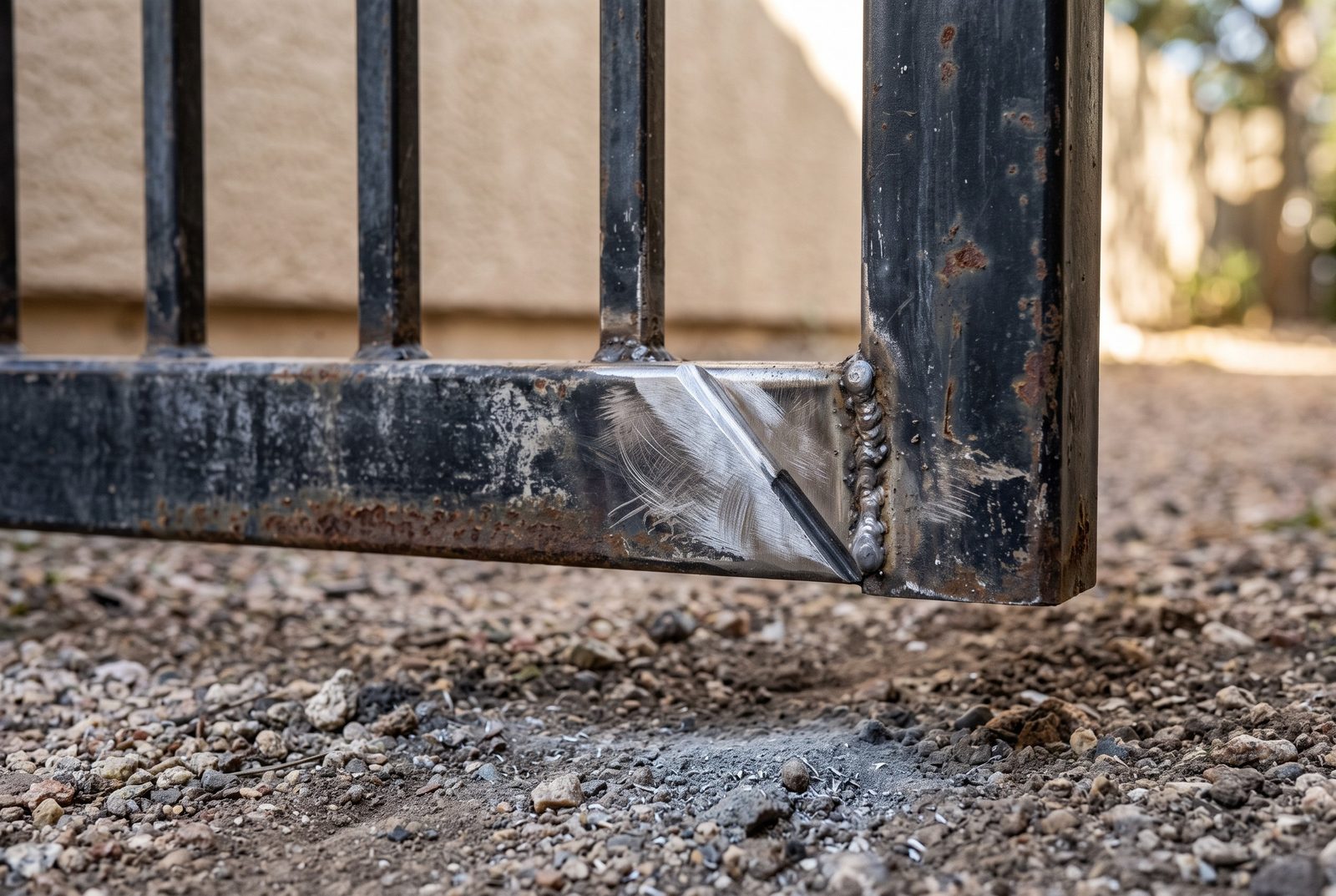
Grind the crack clean
Water settles in the bottom rail, so its corners lose wall first. Where the steel holds, a crack is ground out to clean metal and welded through.
-
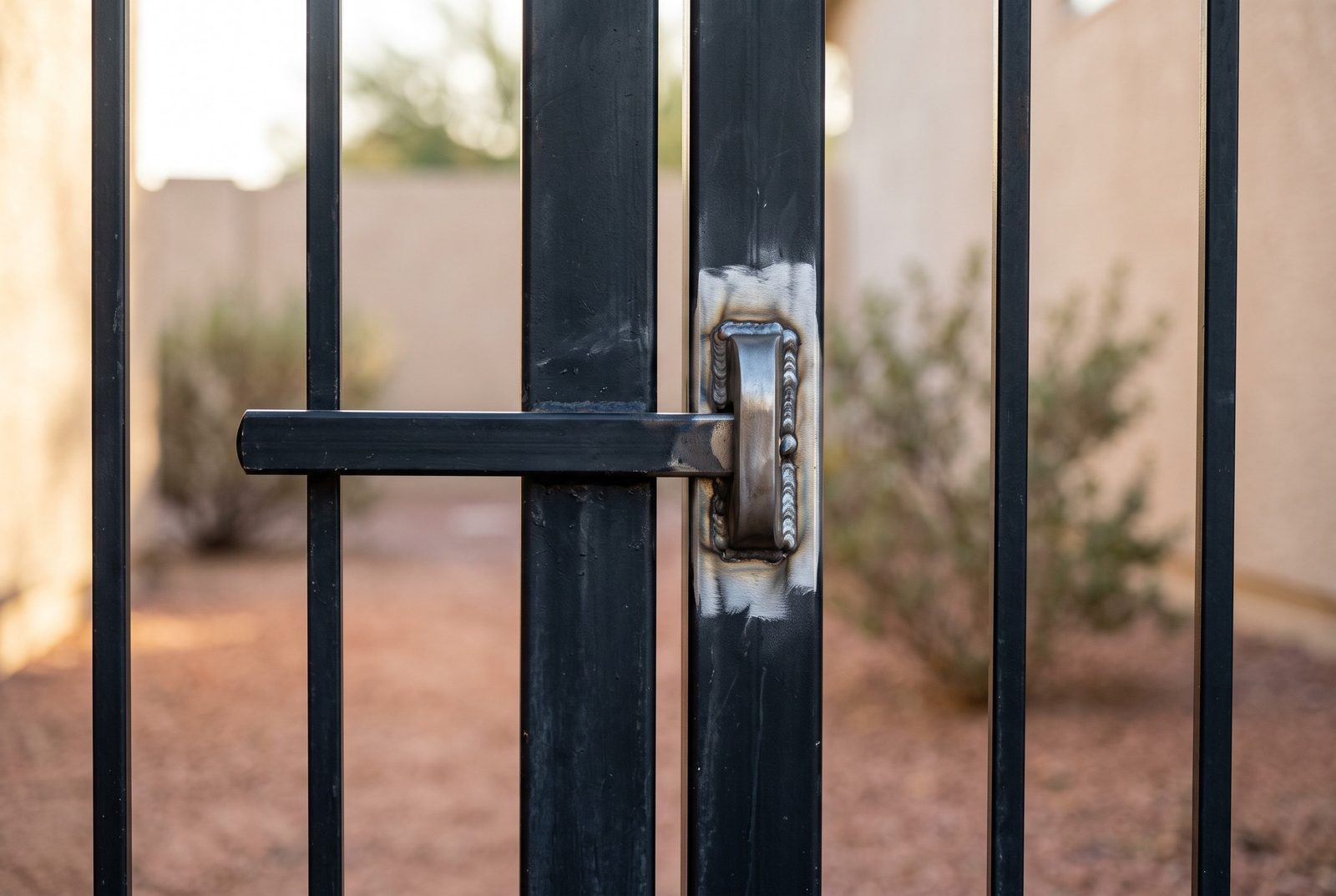
Level, then weld
A latch that stopped catching usually means the leaf has dropped. The leaf comes back up first, then the keeper is welded where the latch actually lands.
-
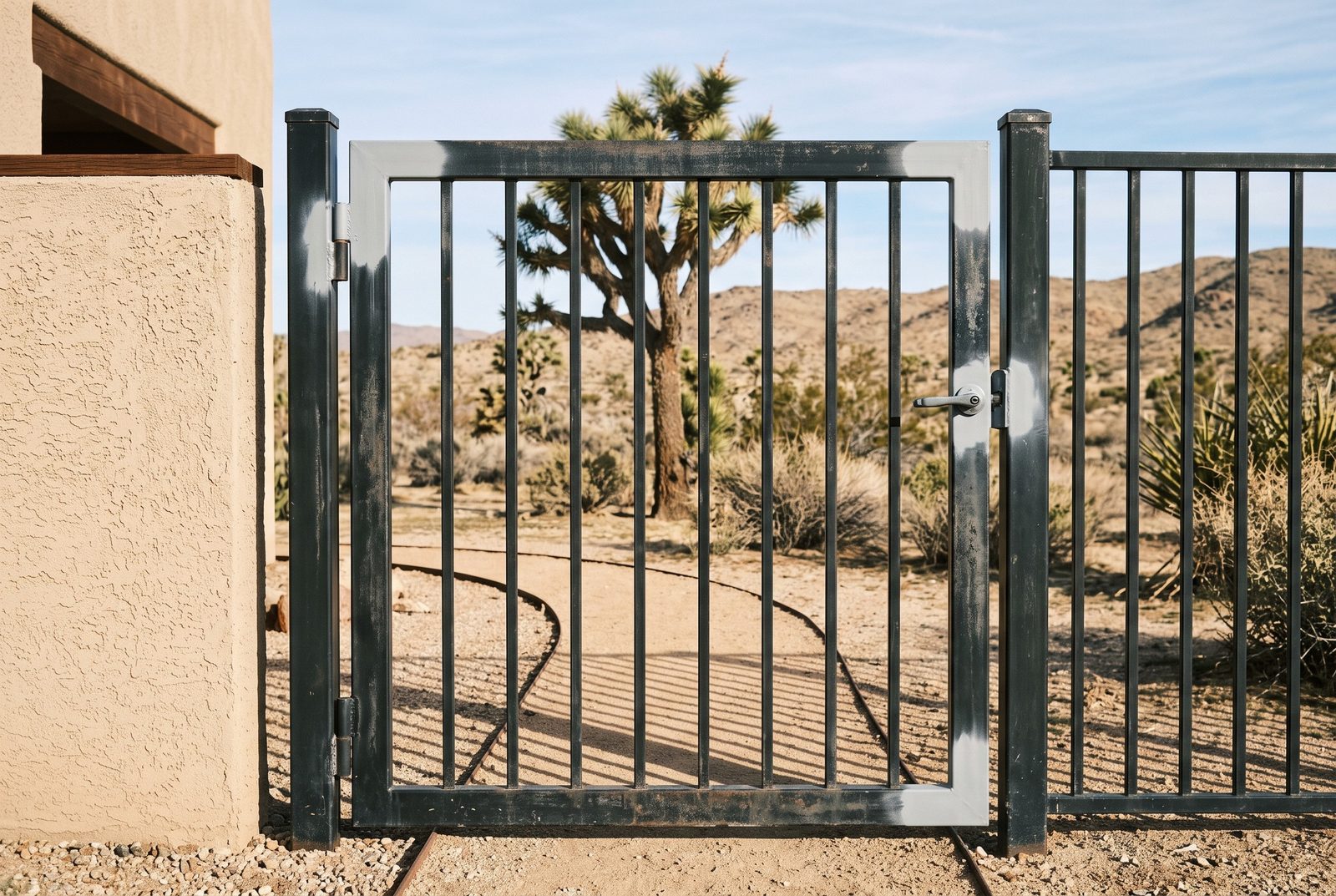
Coat the weld area
A gate on its hinges cannot go back into a galvanizing kettle, so each weld area is ground clean, coated with a zinc rich compound and topcoated.


The hinge side
Every pound of a leaf hangs from two hinges on one post. When a hinge tab tears loose, look at that post before the hinge. A post too light for its leaf flexes on every swing, and a new hinge welded to the same post pulls off the same way. So the post gets a heavier section, or a plate welded along the hinge line, and only then does a new hinge go onto sound steel. Hinges worn oval are cut off and new ones welded in their place.

The latch side
A latch that stopped catching is usually reporting something else. When a leaf drops on its hinges, the latch edge drops with it, and the latch no longer meets its keeper. Welding the keeper lower to chase it hides the sag for a while and lets it keep growing. We bring the leaf back up first, then weld the keeper where the latch actually lands.
Double gates split their welds in the middle. The passive leaf is held by a drop rod sitting in a sleeve in the drive. Once that leaf sags, the rod misses the sleeve, and the habit of slamming the active leaf into it to make the latch bite cracks the welds along that edge. Both leaves get leveled and the receiver reset. A longer rod is not the fix.
Pool gates have a state standard. California Health and Safety Code 115923 has the access gate swing away from the pool, close on its own, and latch itself, with the latch no lower than 60 inches above the ground. A latch we weld or move goes back to those terms.
The frame and its brace
A gate frame is a rectangle of tube, and a rectangle folds at the corners under its own weight. A diagonal running up from the lower hinge corner to the upper latch corner turns it into two triangles, and triangles do not fold. Plenty of older gates were welded without one. Adding a brace is quick, but only on a frame that is square already. Welded into a racked frame, a brace locks the droop in for good. That leaf comes to the shop, gets clamped flat and true on the table, and gets its diagonal there.
Bottom rails and corners
Water finds its way into the tube and settles at the bottom of a gate, so the bottom rail and its two corners lose wall first. Press a screwdriver into the underside of the rail near each corner. Where it holds, a crack is ground out to clean metal and welded through. Where the tip punches in, that length of rail is cut away and new tube welded in.
Changing a gate you own
In Lancaster, a taller gate is a code question before it is a welding one. Inside city limits, Lancaster Municipal Code 17.08.130 ties fence height to the setback: 4 feet in the front yard setback, 6 feet in a side or rear setback, and a director's review can approve up to 25 percent more. Ask the planning counter how they read a gate in your fence line. Unincorporated county land next to the city follows LA County Code 22.110.070 instead. Settle the number before we cut extension pieces.
Turning open pickets into a solid face changes the load on everything holding the gate up. Pickets let most of a gust through, and a solid sheet stops all of it. The National Weather Service station at Fox Field in Lancaster recorded a 49 mph gust on January 8, 2026. Before sheet goes onto an old picket frame, we check that the hinges and the post can carry it.
Say so if a motor might come later. The frame and hinges get welded for the extra work an operator adds, along with stops or catch brackets, because ASTM F2200 holds a powered gate to falling no more than 45 degrees from vertical if it leaves its hardware. Any steel we add must not leave a gap under 16 inches between the moving gate and a fixed edge, up to 6 feet above grade, which UL 325 counts as an entrapment zone. The motor, its wiring and its controls belong to other trades.
Mobile or in the shop
Across Lancaster, hinges, latches, keepers, cracked welds and a plate on a standing post are mobile work: the welder comes to the gate. A racked frame or a brand new leaf comes to the Lancaster shop. Wind decides some site days, since it strips shielding gas from the arc and leaves porosity in the weld. Miller Electric points to a windshield or self-shielded flux-cored wire for that kind of work.
Welding burns off the coating around each joint. A gate still on its hinges cannot go back into a galvanizing kettle, so the weld area is ground clean, coated with a zinc rich compound and topcoated. The new patch looks a little fresher than the steel beside it. Where looks matter, we coat the whole rail rather than one joint.
A gate past saving is better replaced; see custom steel gates in Lancaster. Diagnosing a gate that drags or will not close is covered under gate repair in Lancaster, and the steel gates page explains how a frame and its posts are sized.
Questions about gate welding in Lancaster
Can you weld my gate without taking it down?
The hinge broke off my gate post. Is a new hinge enough?
Can you add a brace to a sagging gate?
Can you make my gate taller?
Will you weld a new latch on a pool gate?
Do you work on automatic gates in Lancaster?
What does gate welding cost in Lancaster?
More of our work in Lancaster
Gate welding in nearby towns
Need gate welding in Lancaster?
Free estimates. Send a photo of the job, or call and we will set a time.