Wet Kit Installation
Hydraulic wet kits installed for running dump and trailer equipment. Pump, tank, valve and lines, sized to what you are running.
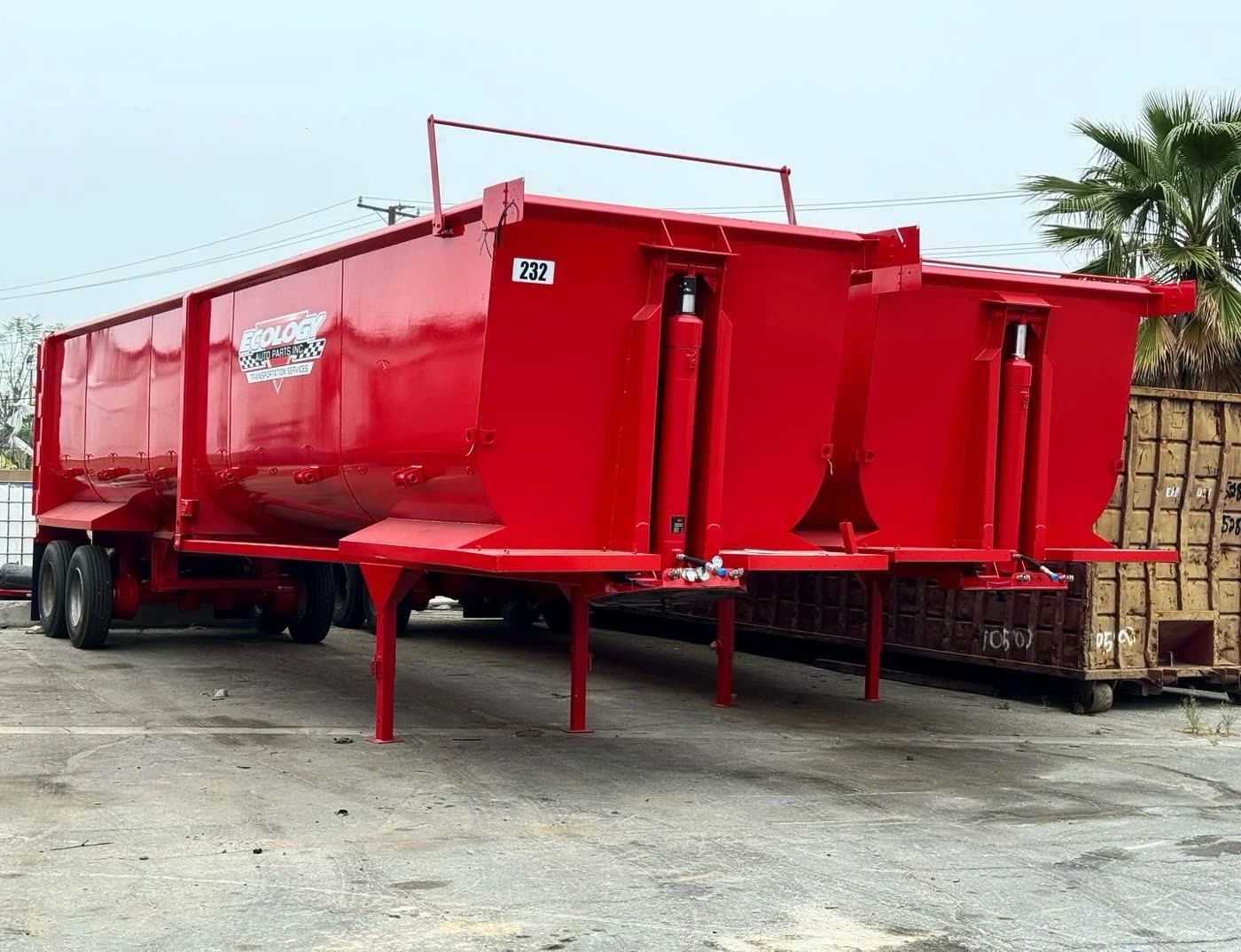
A wet kit is the hydraulic system that lets a truck tractor run a trailer's hydraulics, most often the hoist on an end dump. A PTO takes power from the transmission, a pump turns it into oil flow, and a tank, a valve and the lines carry that oil to the trailer and back. We install the whole system: pump, tank, valve and lines.
Sizing starts at the far end, with the equipment being driven. ProDrive PTO, which makes PTOs and hydraulic pumps, sets out the method in its guide to sizing a wet kit pump. The cylinder comes first: it needs a certain flow to move at the speed you want and a certain pressure to move the load, and everything upstream is chosen to supply those two numbers.
Pump flow comes from displacement and speed. A gear pump moves a fixed volume of oil each revolution. In ProDrive's formula, flow in gallons per minute is the displacement in cubic inches times the pump RPM, divided by 231, and pump RPM is engine RPM times the PTO ratio. Their worked example is a 2.3 cubic inch pump on a 1.0 ratio PTO, which gives about 9 GPM at a 900 RPM idle and about 12 GPM at 1,200 RPM. The guide's advice is to size at the engine speed the operator will actually use during the cycle, not the maximum.
Pressure brings the second check. The load sets the pressure, but the pump has to be rated for it and the PTO has to supply the torque. ProDrive puts torque at the pump shaft, in pound feet, at roughly the displacement in cubic inches times the pressure in PSI, divided by 75. A 2.3 cubic inch pump at 2,500 PSI needs about 77 pound feet. That figure gets compared with the intermittent torque rating on the PTO spec sheet and with the transmission maker's PTO limit before anything is ordered.
The tank is the part most often undersized. ProDrive says the tank should hold at least the volume of the largest cylinder plus a reserve, and that in practice it sizes tanks at two to three times the pump's flow per minute on open center systems. On the suction side the guide calls for a hose one size larger than the pressure hose, so the pump never starves, and names cavitation from a small suction line as the leading cause of early gear pump failure it sees.
Those checks explain the usual wet kit complaints. A pump sized for a small hoist raises a larger one slowly, because the flow is fixed while the oil volume has grown. A pump fed through a small suction hose fails early. Both trace back to a number that was guessed rather than worked out, and both are cheaper to settle before the kit goes on than after.
The hoist side of the same calculation is covered on our telescopic hoist installation page. Bring the tractor's transmission model, the trailer's hoist or cylinder size, and the raise time you are after. Wet kit work is done at both the Division Street shop in Lancaster and the Penrose Street shop in Sun Valley.
Questions about wet kit installation
Will one wet kit run any trailer?
How big should the hydraulic tank be?
Why does engine speed matter for the pump?
Can my PTO handle a bigger pump?
Often paired with wet kit installation
Need wet kit installation?
Free estimates. Tell us the job and we will send back a spec and a price.