Driveway Gates
Single swing, double swing and slide gates, built in steel to the width of one opening. We measure the drive first, cut the frame to those numbers, set the posts and hang the leaf. Infill runs from open picket to solid face, and the frame gets sized for an operator if you want one later.
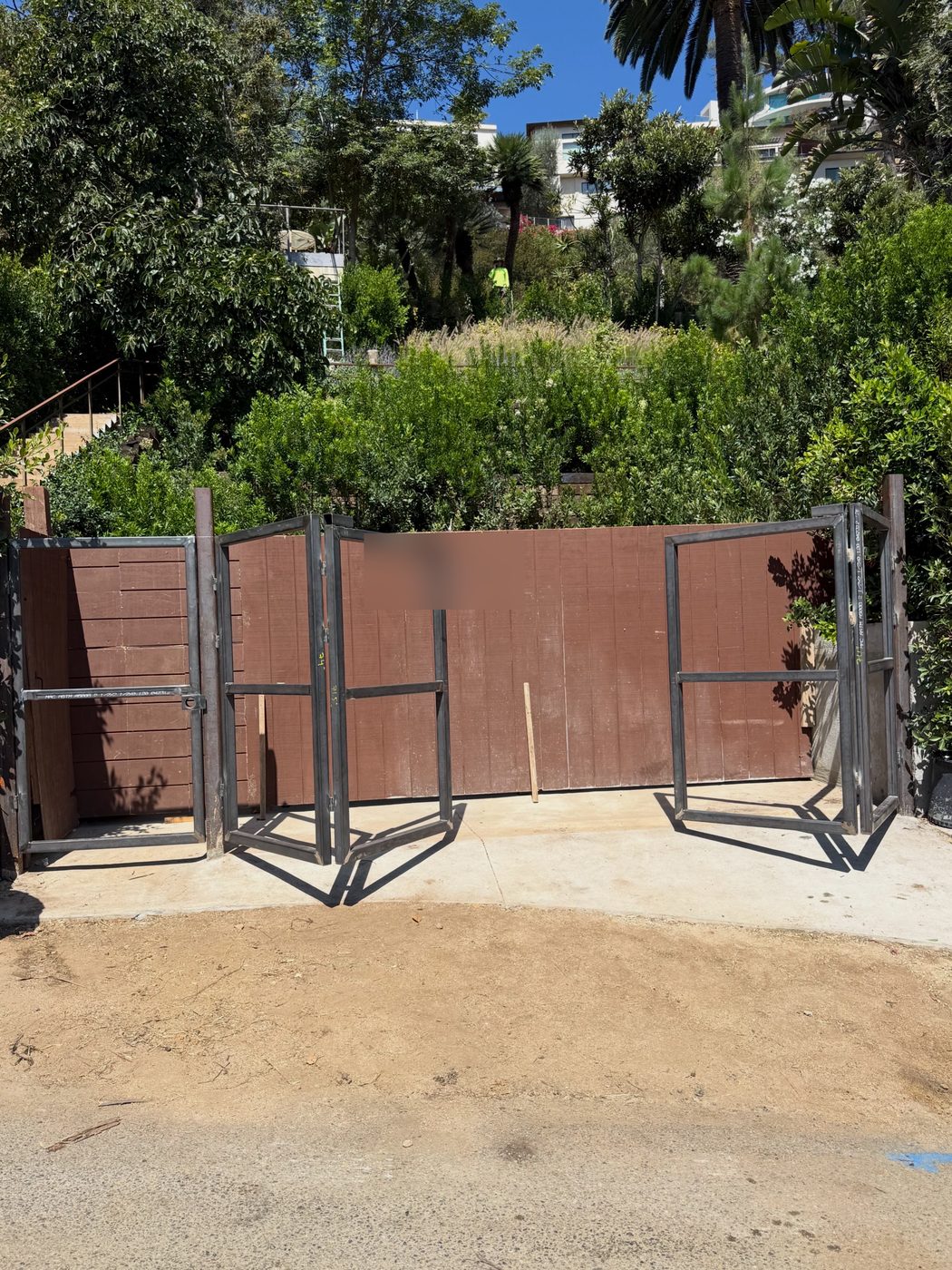
Post size follows the width of the gate, because a gate post works as a vertical cantilever. The leaf hangs off one face, so the demand is the weight times how far that weight sits out from the post. Widen the gate and the load climbs faster than the width does. A single leaf carries the whole opening on one post and one set of hinges. Two leaves split that load. Our sections step up with the leaf, and we set gate posts at least 36 inches into concrete, deeper on a wide leaf or a solid panel. That depth is our own practice.
A solid panel and an open panel do not load the post the same way. A solid steel face has no gaps, so the whole face catches the wind and drives it into the post and the footing under it. A picket or open panel lets most of the air pass through, so only a fraction of the area pushes back. A solid gate of the same width takes a heavier post and a deeper footing than an open one.
ASTM F2200 sets construction rules for automated vehicular gates. Positive stops at both ends of travel, guarded or covered rollers on a slide gate, screening that a 2.25 inch sphere cannot pass, and a frame that cannot fall more than 45 degrees from vertical if it comes off its supporting hardware are all build decisions, so we make them in the shop. Swing gates do not carry the screening requirement.
UL 325 sorts operators into four classes, from Class I residential for one to four families to Class IV guarded restricted access. Class II covers commercial and multifamily of five units or more. Under UL 325 each entrapment zone needs two independent means of protection, and the same type cannot be used for both. Every external device is monitored, so the operator will not run normally with one missing or faulted, and reversal begins within 2 seconds.
As summarized in DASMA Technical Data Sheet 350, an entrapment zone is a gap of less than 16 inches between a moving gate and a fixed opposing edge, up to 6 feet above grade on a swing or slide gate. That is the point where a gap has to be guarded, which is a different thing from how far the gate clears the ground.
Speed is capped too. Slide gate operators for Classes I and II, and vertical lift operators, are held to 1 foot per second when the operator is pulling 75 pounds or more, which is UL 325 by way of DASMA Technical Data Sheet 353. None of it is retroactive, so an old manual gate is not in breach for being old. It applies the moment that gate is motorized. A gate that has dragged for years gets a motor, and the whole assembly has to hold up to a standard it was never built to. What we usually find then is a frame racked out of square or hinges worn oval. That steel gets rebuilt before the operator goes on.
The finish is what carries the steel through desert sun. Hot dip galvanizing to ASTM A123 ties coating thickness to the thickness of the steel, so a heavier wall carries a heavier coating. Powder over galvanizing is a duplex system, and the American Galvanizers Association puts it at 1.5 to 2.3 times the combined life of both coatings alone. Prep is what makes it hold. ASTM D7803 adds a thermal pretreatment step that stops outgassing, and skipping it is the usual reason pinholes show up. For color, ask for an AAMA 2604 class powder. Those tiers are written for coatings on aluminum, and the basic 2603 tier chalks faster in this sun.
Work from our shops
Questions about driveway gates
How do I know whether I want a double swing gate or a slide gate?
What should I have ready before you come out to measure?
Can a gate be built now and motorized later?
Do you work on gates you did not build?
Does UL 325 apply to a gate with no motor on it?
Often paired with driveway gates
Need driveway gates?
Free estimates. Tell us the job and we will send back a spec and a price.